
Our ESG commitment: It’s in our DNA
At the heart of our mission lies a firm belief: sustainability is not a standalone initiative but a responsibility. ESG principles (Environmental, Social and Governance) are embedded in our strategy, daily operations and long-term vision. In 2026, we published our first sustainability report under the VSME framework, prepared on a consolidated basis for the EnergyVision Group. We report in a structured way on our environmental, social and governance impact and on the next steps we are taking to further improve our performance.
Our approach is built on three core values: determination, integrity and transparency. They guide how we make decisions, how we work with employees, customers, suppliers, financial partners and local communities, and how we take responsibility for our impact.
Environmental impact: measuring, reducing and accelerating
As a renewable energy player, we want to accelerate the energy transition while systematically monitoring and reducing our own environmental footprint. In our 2025 ESG report, we focus on energy consumption, greenhouse gas emissions, circularity, waste management, biodiversity and water.
We accelerate the energy transition through local renewable energy solutions, including solar energy, charging infrastructure and, since 2025, the first wind assets in our portfolio.
Our Scope 1 emissions amounted to 442.25 tCO2e, mainly due to fuel consumption by company vehicles. Our total Scope 1 and Scope 2 emissions amounted to 486.54 tCO2e market-based and 538.12 tCO2e location-based. With 2025 as our reference year, we are developing formal CO2 reduction targets and a structured reduction plan in 2026 for our Scope 1 and Scope 2 emissions.
All electricity consumed in our offices, warehouses and charging infrastructure comes from certified renewable electricity, supported by Guarantees of Origin.
We promote circularity by extending the lifetime of installations, preferring repair and reuse where technically and economically feasible, and cooperating with certified recycling systems.
According to our reporting, photovoltaic panels are 99.59% recyclable or reusable. Recycling contributions are paid in advance to support responsible end-of-life management.
In 2025, our total water withdrawal amounted to 1,214 m3. Of this, 420 m3 was withdrawn at sites located in areas of high water stress, mainly in Casablanca. Our activities do not include industrial production or water-intensive processes.
Our direct biodiversity impact is limited: two sites are located near Natura 2000 areas, but not within their boundaries.
We aim not only to accelerate renewable energy, but also to be transparent about how we measure, manage and improve our own impact year after year.

Social responsibility: empowering people, supporting communities
We believe in inclusive growth. The energy transition must be affordable, accessible and understandable for households, businesses and communities. At the same time, we want to create a safe, fair and supportive working environment for our employees.
- We invest in training and development. In 2025, the average number of training hours was 36 hours per employee.
- We promote social inclusion by offering opportunities to people from diverse backgrounds, including through training, guidance and sustainable career paths.
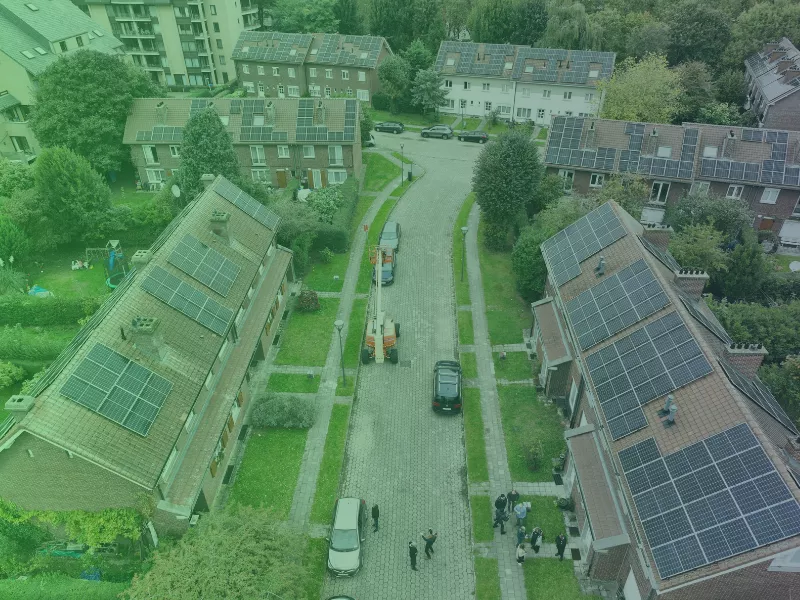
- In Belgium, we support low-income households through safe, long-term and affordable energy solutions, including in collaboration with social housing partners.
- In Morocco, we contribute to access to affordable and reliable energy, so that local communities can better respond to their own energy needs.
In this way, we create social impact at multiple levels: for employees, customers, residents, partners and communities.
Responsible supply chain: fair, traceable and resilient
Our value chain is essential to our sustainability approach. We purchase the technologies and components needed for the energy transition, while also recognising that global production chains can entail risks related to working conditions, human rights, raw materials and environmental impact.
- For non-European suppliers, we apply a supplier code of conduct that prohibits child labour, forced labour and discrimination, and sets clear expectations on health and safety, fair wages and working conditions.
- We screen suppliers against sustainability criteria and expect compliance with our ESG standards and code of conduct.
- We carry out targeted supplier visits and ESG audits, with particular attention to suppliers in Asia. During these visits, we assess quality, working conditions, health and safety, and sustainability practices, among other areas.
- We strengthen the resilience of the production chain through long-term partnerships, geographical diversification and ongoing assessment of upstream risks.
In this way, we aim to take responsibility beyond our own organisation, while safeguarding the continuity and quality of our projects.

Governance: integrity in action
Our governance approach is based on transparency, accountability and ethical conduct. Formal instruments such as our code of conduct, supplier code of conduct, whistleblowing procedure and internal controls support an ethical and responsible way of working. Our code of conduct and whistleblowing procedure are publicly available. The supplier code of conduct, work regulations and purchasing policy are available on request.
- ESG is monitored through internal coordination between the relevant functions and responsibilities within the organisation, with reporting and discussion at board and management level.
- In 2025, 4 of the 9 members of the Board of Directors were women. We continue to integrate diversity and balanced representation into appointment, succession and leadership development processes.
- EnergyVision applies a zero-tolerance policy towards corruption and bribery.
Strong governance helps us build trust, identify risks in a timely manner and steer our growth responsibly.
Focused on what matters
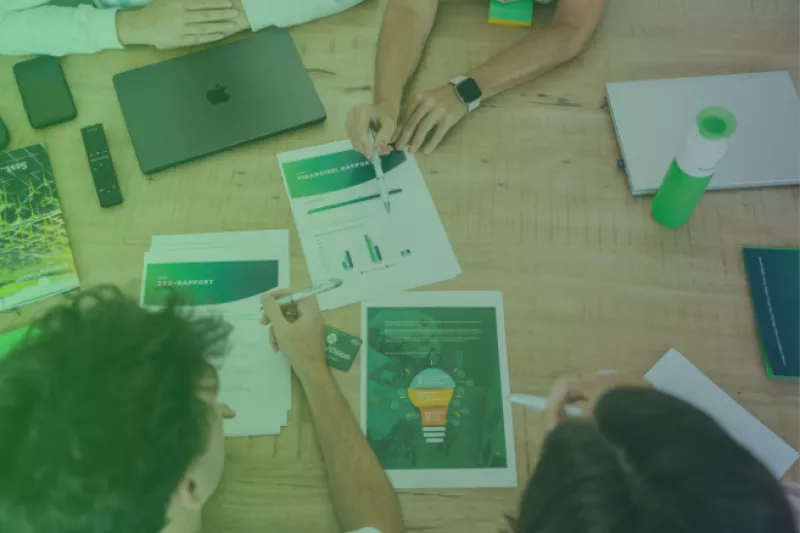
We went through a structured process involving internal stakeholder engagement, external interviews, questionnaires, desk research, value chain analysis and an impact and financial relevance assessment. This process helps us monitor the ESG topics that are most relevant to EnergyVision and our stakeholders.
- Environment: energy and greenhouse gas emissions, climate transition, circularity and waste management.
- Society: working conditions, remuneration, training, health and safety, human rights and social inclusion.
- Supply chain: labour rights, human rights, supplier engagement, traceability, responsible procurement and production chain resilience.
- Governance: ethical conduct, anti-corruption, whistleblower protection, gender diversity, internal controls and transparent reporting.
Looking ahead
2025 was the first year in which we reported our sustainability information in a fully structured way under VSME. That process generated valuable insights and forms the basis for further professionalisation.
- In 2026, we are developing formal CO2 reduction targets and a reduction plan based on our 2025 Scope 1 and Scope 2 reference.
- We are continuing the electrification of our fleet and aim to phase out fossil-fuel passenger cars.
- We remain committed to certified recycling of photovoltaic panels that reach the end of their lifetime.
- We are strengthening our data quality, monitoring and reporting on emissions, waste, energy, water, safety, training and supplier follow-up.
Our ambition remains clear: to build a resilient, future-proof company that accelerates the energy transition while taking responsibility for people, planet and progress.